Press resources
Book details
Title: The Comeback Plan
Subtitle: The ICU Doctor’s Guide to Bringing You Back From the Brink
Publisher: Short Books
Publication date : 25 Mar. 2027
Print length : 256 pages
ISBN-10: 1804194425
ISBN-13: 978-1804194423
Short pitch
Survival is not the finish line. It is the starting line. An intensive care doctor's honest, evidence-based guide to rebuilding after your life breaks.
Cover endorsement
“The ultimate recovery guide for body, mind and soul.”
Xand Van Tulleken
Medium pitch
Prevention dominates the health shelves. But sooner or later most of us crash anyway whether it’s through illness, surgery, cancer, burnout, grief or the slow erosion of midlife. The Comeback Plan is about what happens next. Written by an intensive care doctor who has watched thousands of people fight their way back, it treats recovery not as rest but as a skill. This can be learned, practised and improved. Survival is not the finish line. It is the starting line. Recovery isn't rest. It's a plan. And this is that plan.
Personal Note
After twenty years at the sharp end of intensive care, the people I remember most are not the ones who needed some dramatic lifesaving procedure at 3am. Those who stay with me are patients I’ve met in clinic months later. Despite the scans being clear, the blood tests normal, they still cannot walk to the end of the street or recognise themselves in a mirror.
So I've written The Comeback Plan, a practical guide to a part of life that nobody prepares you for. The book rebuilds in three stages: body first, then your mind, before turning to the things that make your recovery worthwhile. It's honest about what works and blunt about what doesn’t. Survival is not the finish line. It is the starting line. Recovery isn't rest. It's a plan. And this is that plan.
Reader blurb
The operation is over. The scans look better. The crisis has passed. And yet you don't feel right.
Every day, intensive care doctor Matt Morgan meets people in the gap between surviving and feeling better. They are tired in a way sleep doesn't fix, anxious in a way reassurance doesn't help and living in a body that feels like it’s been borrowed.
The Comeback Plan is the guide he wishes all patient are given on the way home from hospital. It rebuilds from the ground up – The Body first, because you cannot rewire fear on an empty tank; then The Mind, so pain and dread don't drive the whole system off course; then The Soul, the meaning and the people that make all of it worth doing. It is grounded in biology, not bravado. No miracle cures. No supplement catalogue.
Survival is not the finish line. It is the starting line.
A book for everyone who has ever said “I used to be fine.”
Press angles
Medicine has never been better at keeping people alive. Yet it has never been less interested in what happens afterwards. Survivors of cancer treatment, major surgery, sepsis, cardiac arrest, and burnout are discharged with a bag of tablets, a follow-up appointment and a leaflet. Then comes the months of fatigue, fear and lost confidence that nobody warned them about.
The Comeback Plan is intensive care consultant Matt Morgan's argument that this gap is the great health problem of our age, and one that is fixable. Recovery, he says, is not rest. It is a skill that can be learnt.
He is unusually direct about the industry that has rushed into the vacuum. Ice baths do not fix trauma. Nothing "boosts" your immune system. Adrenal fatigue is not a diagnosis. Chapters titled "Things I Won't Pretend Work" name what the evidence does and doesn't support, and what the wellness market costs exhausted people in money, time and hope.
Morgan writes from both sides: as the doctor who follows patients from the ventilator to the follow-up clinic, and as a patient who ruptured his Achilles and had to learn his own advice the hard way.
For professionals
The Comeback Plan is a practical, evidence-based guide to post-acute recovery, written for patients but grounded in the rehabilitation and critical care literature.
Its organising claim is that recovery is infrastructure rather than a single act, and that the components have a necessary sequence: physical reserve first (muscle, nutrition, sleep, energy), then autonomic and cognitive regulation (breathlessness, intrusive memories, health anxiety, fear-avoidance, insomnia, burnout), then meaning, identity and social connection. The book treats setbacks as data rather than failure, and applies the minimum effective dose as a working principle throughout.
It covers post-intensive care syndrome, recovery after major surgery and cancer treatment, post-viral fatigue and pacing, persistent pain, grief, and the diagnostic red flags that should send someone back to a clinician rather than to a chapter. Ten ground rules at the front make its scope explicit: use alongside a clinician, not instead of one.
It is also a corrective. Dedicated sections set out what the evidence does not support including supplement claims, cold and heat protocols beyond their real indications, immune "boosting", adrenal fatigue . Wellness noise can actively misdirect exhausted people away from cheap, unglamorous interventions that work.
Useful for anyone running a follow-up clinic, a rehabilitation service, or a conversation on a discharge day.
Festivals and events
There is a moment in intensive care when the numbers improve, and someone says the words everyone has been waiting for “the worst is behind you.” Dr Matt Morgan has said it himself. He has also followed those same patients into the months afterwards, when the stitches are out, the scans are clear and the person sitting opposite him does not feel saved. They feel lost.
The Comeback Plan is about that gap, and it makes a talk that lands with almost any audience because everyone in the room has either been in the after, or loves someone who is.
Morgan takes audiences from the sharp end of critical care into the long, quiet stretch that follows, through the people he has cared for: Diane, sitting on the edge of the bath to dry her feet after her cancer surgery went well; Alex, brought back from a cardiac arrest and undone months later by a supermarket queue; Rhys, rebuilt with real skill by a burns unit and unable to name a reason to leave the house. Alongside them are the public comebacks from Éric Abidal, Monica Seles, Tom Lockyer and his own, an Achilles tendon that snapped and a first 10k that mattered more than the marathons before it.
It is a warm, funny, unsentimental hour with a real argument inside it: that recovery is a skill rather than a temperament, that the wellness industry sells exhausted people the wrong things, and that Life 2.0 is not a consolation prize.
He can also give an audience something to take home - the ten ground rules of recovery, the worst-day plan, and the new words he has invented for the parts of recovery that have never had names: “Gladlag”, the delay between everyone else's relief and your own; “Hopedrawer”, the kitchen drawer of half-finished supplements.
Suitable for main-stage, health and science strands, wellbeing programmes, and staff or leadership events.
Bio long
Matt Morgan is a Consultant in Intensive Care Medicine, Honorary Professor for the Public Understanding of Medicine and a regular BMJ columnist. He is medical advisor to the National Theatre's Nye — the story of Aneurin Bevan, starring Michael Sheen — BBC Radio 4's panel show Best Medicine, Casualty, and the forthcoming Channel 4 series Stepping Up.
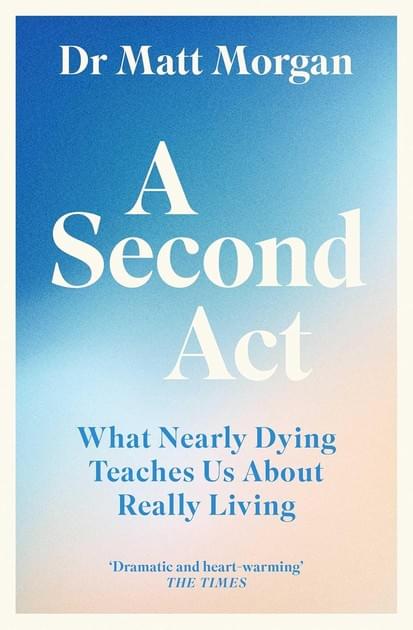
Through three books published by Simon & Schuster, he has asked what it truly means to be alive. CRITICAL took readers inside the intensive care unit to witness life at its most fragile. ONE MEDICINE uncovered the threads binding every species together, and what a giraffe's breathing can teach us about asthma. A SECOND ACT, an Observer Book of the Week, follows ten people who survived a cardiac arrest and the lessons their recoveries hold for the rest of us.
His fourth book, THE COMEBACK PLAN, argues that survival is not the finish line. It is the starting line: a science-backed guide to rebuilding a life after major illness, surgery, cancer, trauma or burnout.
He has contributed to more than fifty peer-reviewed scientific articles following a PhD in artificial intelligence, and has written for the Guardian, The Times, The Spectator and Esquire. His broadcasting spans BBC Radio 4's Today Programme to CNN, Sky and the BBC.
He delivered the Woodridge and James Reason Lectures, has spoken at the Wellcome Trust and at the world's leading book festivals, was nominated for the Royal Society's David Attenborough Prize, and was named among the fifty most influential people in health technology.
He is a member of the BMJ Commission on the Future of the NHS, founder of The Dictionary of Blood and Silence, ambassador for the bereavement charity 2 Wish and patron of the Humanimal Trust. He lives in Cardiff with his family and loves ice cream.
Bio short
Matt Morgan is a Consultant in Intensive Care Medicine, Honorary Professor for the Public Understanding of Medicine and a regular BMJ columnist. He is the author of Critical, One Medicine and A Second Act, and is medical advisor to the National Theatre's Nye, BBC Radio 4's Best Medicine and the forthcoming Channel 4 series Stepping Up. He has written for the Guardian, The Times and Esquire, broadcast on Radio 4's Today programme and CNN, and sits on the BMJ Commission on the Future of the NHS. He was nominated for the Royal Society's David Attenborough Prize. He lives in Cardiff with his family, and loves ice cream.
Downloads
Contact
For interviews, events and media enquiries, or to request a review copy, contact Charlotte Seymour at charlotte@johnsonandalcock.co.uk
Social links
All writing and podcasts:
https://authory.com/drmattmorgan
YouTube:
youtube.com/@Dr_MattMorgan
Instagram:
instagram.com/dr_mattmorgan
Facebook:
www.facebook.com/DrMattMorgan
X:
X.com/dr_mattmorgan
Linkedin
https://www.linkedin.com/in/drmattmorgan/